The Assembly
Committees
Organizer committee
- Comisión Española de Geodesia y Geofísica (CEGG)
- José Antonio Sánchez Sobrino
- E.T.S.I. en Topografía, Geodesia y Cartografía (UPM)
- Ramón Pablo Alcarria Garrido
- José Juan Arranz Justel
- José Luis García Pallero
- Jorge Miguel Gaspar Escribano
- José Manuel Gómez Giménez
- Juan Francisco Prieto Morín
- Joaquín del Río Reyes
- Izar Sinde González
- Alejandra Staller Vázquez
Scientific committees
S01 – Geodesy
- Esther Azcue Infanzón (Instituto Geográfico Nacional)
- Helena Cristina Ribeiro (Direção-Geral do Território)
- David Rodriguez Collantes (Real Instituto y Observatorio de la Armada)
S02 – Seismology and Physics of the Earth’s Interior
- Julián García Mayordomo (Instituto Geológico y Minero de España – CSIC)
- Luís Matias (Instituto Dom Luiz, Universidade de Lisboa)
- Lucía Lozano López de Medrano (Instituto Geográfico Nacional)
S03 – Geomagnetism and Aeronomy
- Joan Miquel Torta Margalef (Consejo Superior de Investigaciones Científicas)
- Maria Alexandra Pais (Universidad de Coimbra)
- José Manuel Tordesillas García-Lillo (Instituto Geográfico Nacional)
S04 – Volcanology
- Carmen López Moreno (Instituto Geográfico Nacional)
- Fátima Viveiros (Universidade dos Açores)
- Adelina Geyer Traver (Consejo Superior de Investigaciones Científicas)
S05 – Meteorology and Atmosphere Sciences
- Fernando Belda Esplugues (Agencia Estatal de Meteorología)
- Rui Salgado (Universidade de Evora)
- Estrella Gutiérrez Marco (Agencia Estatal de Meteorología)
S06 – Physical Oceanography
- Manuel Vargas Yáñez (Instituto Español de Oceanografía – CSIC)
- Alexandra Maria Francisco Cravo (Universidade do Algarve)
- Elena Tel Pérez (Instituto Español de Oceanografía – CSIC)
S07 – Hydrology
- Luis María Garrote de Marcos (Universidad Politécnica de Madrid)
- Teresa Condesso de Melo (Universidade de Lisboa)
- Mirta Dimas Suárez (Centro de Estudios y Experimentación de Obras)
S08 – Applied Geophysics
- Fernando Bohoyo Muñoz (Instituto Geológico y Minero de España – CSIC)
- Elsa Ramalho (Laboratório Nacional de Energia e Geologia)
- María del Carmen Rey Moral (Instituto Geológico y Minero de España – CSIC)
S09 – Cryospheric Sciences
- Miguel Ángel de Pablo Hernández (Universidad Alcalá)
- António Manuel de Carvalho Soares Correia (Universidade de Evora)
- María Gema Llorens (Consejo Superior de Investigaciones Científicas)
Registration
To participate in the AHPGG, you must register for the conference. Registration options are as follows:
| Student registration* To prove student status, the receipt or proof of enrollment for the current course (including student details, degree or postgraduate level, subjects and payment confirmation) must be attached at the end of the registration form. | 150,00 € |
| Until May 15th: Early bird registration* | 250,00 € |
| Starting May 15th: Regular registration* * Student, early bird and regular registrations include assembly documentation, access to scientific sessions and workshops, oral or poster presentation of the submitted communication, publication of the communication in the assembly proceedings, coffee breaks, visit to the Royal Astronomical Observatory of Madrid with catering, visit to ETSI Mines and Energy – UPM with cocktail dinner. | 300,00 € |
| Limited Registration for Undergraduate or Master’s Students (No Visits) This registration option is exclusively for undergraduate and master’s students and includes conference materials, access to scientific sessions and workshops, oral or poster presentation of the submitted paper, publication of the paper in the conference proceedings, and coffee breaks. It does NOT include: visits to Royal Astronomical Observatory of Madrid and ETSI Minas, or associated catering. | 75,00 € |
| Companion registration Companion registration includes only ROAM and ETSIME visits with catering and cocktail dinner respectively | 100,00 € |
To participate in AHPGG 2026, it is necessary to register through the Event Management System of Universidad Politécnica de Madrid. The following guide covers the registration process in the Event Management System of Universidad Politécnica de Madrid, the submission of the abstract, and registration for AHPGG 2026: Instructions for authors
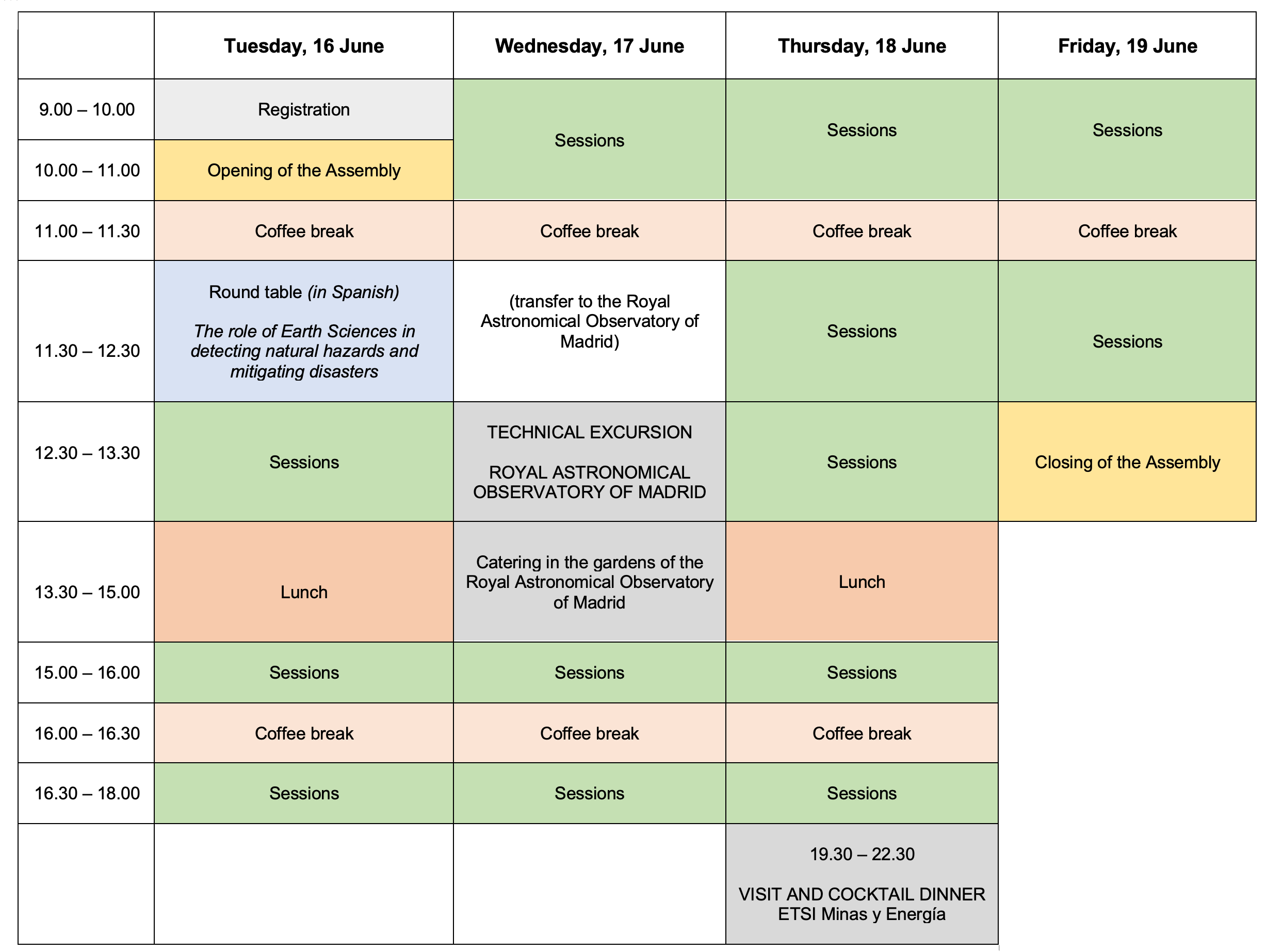
Preliminary program
AHPGG 2026 will be held at the School of Topography, Geodesy, and Cartography (Universidad Politécnica de Madrid, UPM), from June 16 to 19, 2026.